Friday, October 23, 2026

How Game Developers Share Builds with Playtesters and Publishers
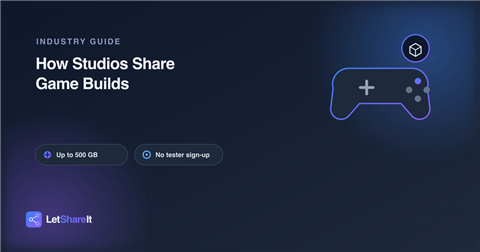
A packaged build with textures, audio, and a few cinematics can clear 10–20 GB before you've shipped anything close to a finished game. Multiply that across weekly playtest builds, a QA pass, and a publisher who wants the latest version before every milestone call, and build distribution quietly becomes its own ongoing chore one most teams solve with whatever happened to work last time.
Why the usual platforms aren't actually built for this
Steam's playtest and beta branches work well once you're set up on Steamworks, but that's a real integration step, not something you reach for to get a build in front of five testers by Friday. Discord caps uploads hard unless your server has boosts, and a big one disappears when the channel's message history scrolls past it. Google Drive works until the build is large enough to eat meaningfully into your account's storage pool, which then starts affecting everything else tied to that account.
Playtest builds: testers shouldn't need an account anywhere
The easier you make it for a tester to actually open the build, the more testers follow through. A link that downloads directly no platform account, no joining a Discord server first, no waiting for a key removes friction right at the moment someone's willingness to bother is lowest. This matters more than it sounds: a playtest signup list is only useful if people in it actually play the build.
Keeping build versions straight
"Which build is this feedback about" is a question that gets harder to answer every week a project runs. Naming each upload with its version or build number, rather than reusing the same filename or the same Discord message every time, means feedback can actually be tied to what a tester was looking at especially important once you're triaging bugs that may already be fixed in a newer build.
Sending builds to a publisher
Publisher check-ins usually want the current build on short notice, and they're evaluating you partly on how smoothly that handoff goes. A reliable link that's always current beats re-uploading to whatever platform they prefer every single milestone, and it means you're not blocked waiting on a slow upload the night before a call because the "official" sharing method choked on the file size.
QA and localization handoffs
If QA or localization is outsourced, the same problem shows up in both directions you're sending builds out, and getting bug reports, screenshots, or translated string files back. Password-protecting the link is worth doing here specifically, since an unreleased build in the wrong hands is exactly the kind of leak that makes gaming press.
What to look for
- No size ceiling that fights a full packaged build. Splitting one build across multiple links just to fit a limit isn't worth the confusion it creates.
- No account required for testers. Every extra step between "here's the link" and "they're playing" loses some percentage of testers.
- Password protection for anything unreleased going to external QA, localization, or publisher contacts.
- A link you can update, so "the current build" always means the current build, not last week's.
On Letshareit, a build goes out as one link up to 4 GB free with no account required on the tester's end, and up to 500 GB per file on paid plans for the heavier packaged builds with full voice and cinematic assets.